
Your Labs are Normal, so Why Don’t You Feel Normal?
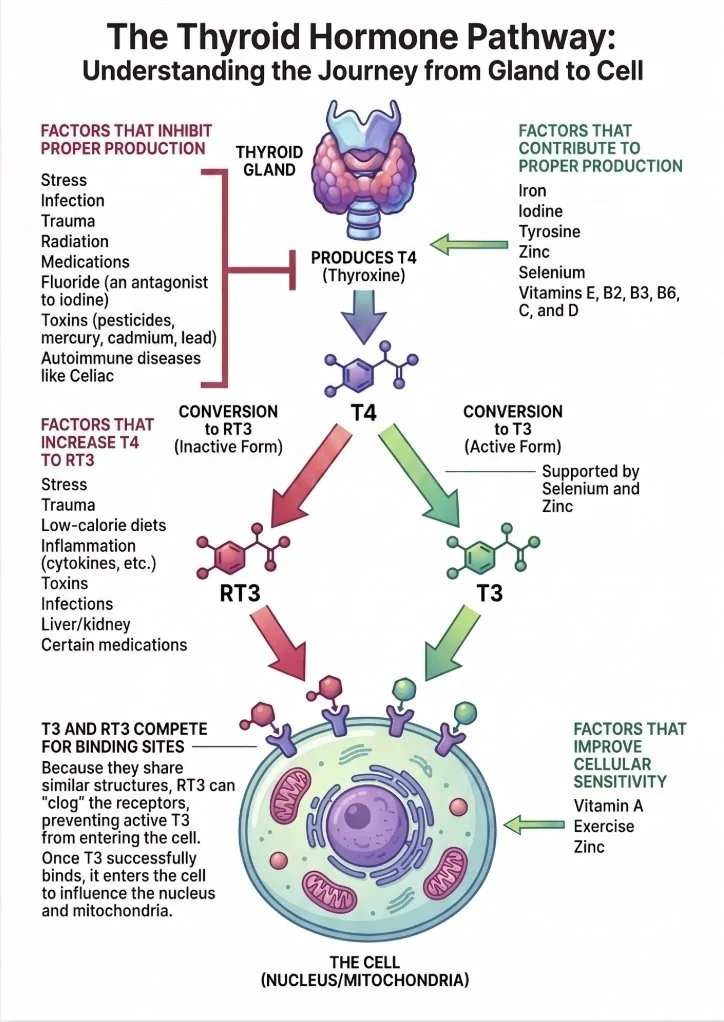
“Your labs look fine,” your provider says as you slink back in the cold chair wondering why you feel so awful then.
You’re exhausted. Your hair is falling out. You’re gaining weight and can’t lose it no matter how hard you try. You have cravings, brain fog, digestive issues, and you feel moody and frustrated.
Why??
This is one of the biggest reasons I am so passionate about functional medicine. Because I don’t believe the answer is simply, “Your labs are normal, so have a good day.”
Your symptoms matter. Your body is intelligent and is letting you know something is off. And my role is to be a detective with you, to look at the clues, connect the dots, and figure out what may be missing.
One of my favorite examples of this is the thyroid.
The thyroid is more than one number
The thyroid affects nearly every system in the body. It plays a role in metabolism, energy, body temperature, digestion, mood, and so much more.
But many people are only getting part of the picture.
They get a TSH (Thyroid Stimulating Hormone) test. It comes back within the reference range. They are told their thyroid is normal.
TSH is an important test. It can be very helpful but it doesn’t tell the whole story.
Your thyroid gland makes mostly T4, which then needs to be converted into T3, the active form of thyroid hormone that your cells use.
For this process to work properly, your body needs the right nutrients, healthy digestion, appropriate hormone signaling, and the ability to properly produce, convert, and use thyroid hormones.
This is why looking at the whole picture matters.
Depending on your symptoms and situation, a more complete thyroid evaluation may include:
• TSH• Free T4• Free T3• Thyroid antibodies (TPO, Thyroglobulin Ab)• Iron status, including ferritin• Vitamin D• Zinc and other nutrients involved in thyroid function
The goal is not to order every test for everyone. The goal is to ask better questions.
The women I see are often told everything is normal
One of the biggest patterns I see is women in their 40s who feel awful and are usually struggling with weight issues. Many are going through major hormonal changes and wondering why their body feels so different. Some no longer have a gallbladder and are struggling with digestion, weight, and feeling like their metabolism has changed.
Many have been searching for answers for years. They are not looking for someone to tell them they are fine. They are looking for someone to help them understand what is happening. This is where I believe we need to look deeper. Because the body is not one isolated system.
Your thyroid does not work alone
The thyroid needs the right environment to function well. It needs nutrients like iron, zinc, selenium, and vitamin D.
But many people are starting with nutrient deficiencies or poor absorption.
As we get older, stomach acid production can decrease. Some medications, including long term acid reducing medications, can also affect digestion and nutrient absorption.
If your body is not breaking down food properly, you may not be absorbing the nutrients your thyroid, hormones, and metabolism need.
Then we add modern life.
Many of us barely spend time outside anymore. We walk from the house to the car, sit inside all day, and wonder why our vitamin D levels are low and why our bodies feel disconnected from nature.
Our food system has changed dramatically. Food can travel thousands of miles before it reaches our plate. It may be grown in depleted soil, exposed to pesticides, processed, packaged, and wrapped in plastic before we ever eat it.
Our homes are filled with chemicals that our bodies were never designed to process at the levels we experience today. Our cleaning products, laundry products, beauty products, furniture, mattresses, and clothing all contribute to the environment our bodies are constantly interacting with.
Women especially are exposed to hundreds of chemical ingredients through the products they put on their bodies every day.
This does not mean that one single exposure determines your health. It means that your body is constantly adapting to your environment.
When you combine chronic stress, poor sleep, nutrient deficiencies, digestive issues, environmental exposures, and hormonal changes, it makes sense that many people do not feel their best.
This is why I look at the whole person
Functional medicine is about putting the puzzle pieces together.
It is about asking:
Why is this person tired?
Why are they gaining weight?
Why are they struggling with hormones?
Why are they not absorbing nutrients?
Why do they feel like they have lost themselves?
Sometimes the answer is thyroid.
Sometimes it is digestion.
Sometimes it is nutrient status.
Sometimes it is hormones, stress, sleep, metabolism, or a combination of many things.
My goal is not to chase perfect numbers.
My goal is to understand the person behind the labs.
Because you are not just a number on a lab report.
You are a whole person.
And if you feel terrible but your labs are “normal,” there is still more to the story.
References and Further Reading
Ashrafi S, Hatami H, Bidhendi Yarandi R, Panahi MH. The prevalence of thyroid disorders in COVID 19 patients: A systematic review and meta analysis. BMC Endocrine Disorders. 2024. https://pmc.ncbi.nlm.nih.gov/articles/PMC10759498/
Rahi R, Singh A, Garima S, et al. Serum Copper and Zinc Status in Hypothyroidism: A Case Control Study Evaluating Their Impact on Thyroid Function. International Journal of Current Pharmaceutical Review and Research. 2026. https://impactfactor.org/PDF/IJCPR/18/IJCPR,Vol18,Issue2,Article40.pdf
Challenges in Interpreting Thyroid Stimulating Hormone Results in the Diagnosis of Thyroid Dysfunction.https://pmc.ncbi.nlm.nih.gov/articles/PMC6778876/
Vitamin D Deficiency Is Associated with Impaired Sensitivity to Thyroid Hormones in Euthyroid Adults.https://pubmed.ncbi.nlm.nih.gov/37686729/
Relationship between Iron Deficiency and Thyroid Function: A Systematic Review and Meta Analysis.https://pubmed.ncbi.nlm.nih.gov/38004184/